Warrior vs Mage vs Rogue: Which RPG Class Is Best? | Entering the gates of a fantasy Role-Playing Game (RPG) always promises a thrilling sense of adventure. Players are instantly confronted with vast worlds filled with monsters, dragons, and mysterious underground labyrinths. However, before swinging your first sword or casting a magical spell, there is one crucial decision to make on the character creation screen: choosing your class.
For RPG enthusiasts, a class is not just a formal title; it is the foundation of your entire playstyle. This system was originally adapted from legendary tabletop games like Dungeons & Dragons. Out of the many variations that have evolved into the modern era, one definitive baseline remains, known in the RPG universe as “The Holy Trinity”: The Warrior, The Mage, and The Rogue.
These three core archetypes divide playstyles into three distinct, complementary focuses: melee dominance, magical versatility, and stealthy precision from the shadows. Understanding the unique characteristics of each class—from how they fight and solve problems to their role within a team—is the ultimate key to finding maximum comfort in your digital journey.
1. The Warrior: The Frontline Protector
Picture a knight in gleaming armor, holding a shield as tall as their body, standing firm against the fury of a giant monster. That is the true essence of a Warrior. Within the RPG ecosystem, they are the solid pillar that supports the entire party. If you enjoy direct, aggressive action and do not fear going toe-to-toe with enemies, this class is tailored specifically for you.
Playstyle and Combat Role
Warriors operate on the frontlines. They generally fill two highly popular roles within the gaming community: a Tank (damage absorber) or a Bruiser/Berserker (a high-damage melee fighter). When fighting alongside a team, a Warrior’s primary duty is to draw enemy attention (aggro) so that monsters focus their attacks on them. This allows fragile teammates to unleash their damage safely from a distance.
Key Stats
A Warrior’s physical prowess is driven by three main attributes:
-
Strength: Increases physical damage output and determines how heavy of a weapon they can swing.
-
Constitution/Vigor: Determines the total health pool (HP pool) so they can survive longer in battle.
-
Defense: Reduces the amount of incoming physical damage taken from enemy strikes.
Strengths and Weaknesses
The primary advantage of the Warrior lies in their incredibly high survivability. They are highly beginner-friendly because their control mechanics tend to be straightforward and uncomplicated. Furthermore, they excel at controlling the flow of close-quarters combat.
However, this class is not without its flaws. Warriors are usually slow in terms of mobility due to the heavy weight of their armor. Outside of taking up arms and fighting, they offer minimal utility or non-combat functions. Lastly, they are entirely reliant on close proximity; enemies utilizing ranged attacks or magic often become a nightmare for a slow-moving Warrior.
Popular Subclasses
As your character progresses, Warriors can typically specialize into several branches of expertise:
-
Paladin: A holy knight who blends physical defense with basic healing magic or protective auras to empower the team.
-
Berserker: A fighter who sacrifices defense to deal massive physical destruction, often growing stronger as their health depletes.
-
Guardian: A pure defensive specialist focused on utilizing massive shields and damage mitigation tactics to protect allies.
2. The Mage: Master of Magic and Strategic Logic
In stark contrast to the physical resilience of the Warrior, the Mage chooses a quiet path, studying the pages of ancient tomes and mastering the magical energies that flow through the universe. They sacrifice muscle power to gain mystical knowledge capable of altering the battlefield landscape in the blink of an eye.
Playstyle and Combat Role
Striking down enemies one by one can be exhausting, and that is where the Mage shines. They fight from a safe distance as a Nuker (high-burst, large-scale damage dealer) or a Controller (situation manager). A Mage’s playstyle highly demands tactical and strategic thinking. This character type is often dubbed a glass cannon; they are capable of unleashing devastating Area of Effect (AoE) damage, yet they will crumble to pieces easily if an enemy manages to close the distance and land a hit.
Key Stats
A Mage’s mystical power stems from managing the following points:
-
Intelligence: The absolute attribute that determines the damage output of casted spells.
-
Wisdom: Often influences the regeneration speed of energy or the effectiveness of healing and spiritual defense magic.
-
Mana/Magic Points (MP): The essential fuel for casting spells. Without these points, a Mage is no more helpless than an ordinary civilian.
Strengths and Weaknesses
The greatest appeal of a Mage is their incredible variety of attacks and their ability to exploit enemy elemental weaknesses (such as using fire magic against ice monsters). They can also obliterate groups of enemies simultaneously in a matter of seconds using area spells.
On the flip side, Mages possess very low physical defense and health pools. Managing character positioning during combat is a matter of life and death. The worst-case scenario for a Mage is running out of Mana mid-battle, leaving them as completely useless, easy targets.
Popular Subclasses
The world of magic is vast, and a Mage can choose the focus of their energy orientation:
-
Wizard/Sorcerer: A pure spellcaster who manipulates natural elements like fire, lightning, and ice to inflict massive damage on enemies.
-
Cleric/Healer: A religious envoy who uses holy magic to restore ally health, provide strengthening effects (buffs), and cleanse curses.
-
Warlock/Necromancer: A dark spellcaster who relies on damage-over-time curses, debilitating hexes, or raising spirits to fight on their behalf.
3. The Rogue: Expert of Agility and Stealth Tactics
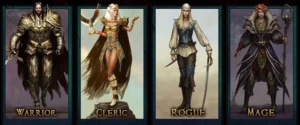
If the Warrior relies on brawn and the Mage utilizes brains, the Rogue relies on cunning, speed, and exploiting momentum. They are opportunists who care little for the concept of a fair fight. For a Rogue, a victory achieved from the shadows is far more elegant than an exhausting open duel.
Playstyle and Combat Role
Rogues move nimbly through the gray zones of the battlefield. They rarely stand still to take a hit. Their playstyle revolves around the element of surprise, critical hits, and evasion capabilities. Their primary role is to swiftly eliminate the most dangerous single targets (such as enemy Mages) before the opposition even realizes what is happening. Outside of combat, the Rogue transforms into a primary utility provider, clearing paths for the team through their ability to detect hidden dangers.
Key Stats
The nimble fingers and footsteps of a Rogue are backed by these attributes:
-
Agility: Increases movement speed, attack frequency, and the chance to dodge enemy strikes.
-
Dexterity: Determines attack accuracy, the chance to land high-damage critical hits, and manual manipulation skills.
-
Luck: Influences the chances of finding valuable items (looting) and triggers unexpected effects during combat.
Strengths and Weaknesses
The main advantage of the Rogue is their unmatched mobility and high independence. They come equipped with a wealth of crucial non-combat skills, such as picking chest locks, disarming dangerous dungeon traps, and scouting ahead to map out enemy positions.
The biggest weakness of this class appears when their stealth tactics fail. When spotted and trapped in a prolonged, open brawl against multiple enemies at once, a Rogue will struggle to survive because their light armor is not designed to absorb heavy impacts.
Popular Subclasses
A Rogue’s specialization is usually divided by their tools and methods of execution:
-
Thief: Focuses on sleight of hand, stealing items from enemies, extra agility, and maximum utility functions inside dungeons.
-
Assassin: A cold-blooded killer who maximizes camouflage abilities (stealth) to deliver a single, lethal strike from behind a target.
-
Ranger/Archer: Combines the agility of a Rogue with ranged weaponry like bows or firearms, often accompanied by a pet companion to aid in the hunt.
Party Synergy: Why They Need Each Other
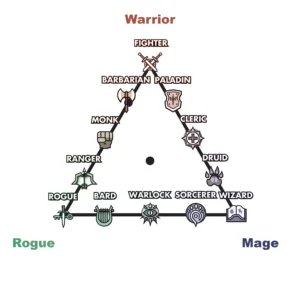
The reason this triangular formula has endured for decades in the gaming industry is the mechanical balance it creates. These three classes are designed to cover each other’s weaknesses.
In a battle against a massive boss, the Warrior stands right at the front to block the swings of the boss’s giant club. At the same time, the Mage, positioned safely far behind, can cast a lightning storm spell without fearing interruption. While the boss is preoccupied hitting the Warrior’s shield and being rained on by the Mage’s lightning, the Rogue sneaks up to the boss’s back to plunge a poisoned dagger directly into its weak spot.
This harmonious combination is what makes the fantasy RPG genre so captivating. Every player has a specific, unique role, making even the smallest contribution feel incredibly valuable to the party’s victory.
Conclusion: Which Class Solves Your Style?
Choosing your first character does not have to be an overwhelming burden. You simply need to align your personality or playstyle preferences with the foundational traits outlined above:
-
Choose the Warrior if you prefer direct action, want to be the heroic protector of your friends, and enjoy characters with massive physical durability.
-
Choose the Mage if you enjoy strategic planning, love seeing massive damage numbers on your screen, and appreciate the aesthetic of magical elemental power.
-
Choose the Rogue if you value freedom of movement, dynamic and clever tactics, and enjoy exploring every hidden secret a game has to offer.
The Holy Trinity system is your basic roadmap. Once you master one of these three pillars, navigating more complex, modern RPG variations will feel much easier and far more enjoyable. Choose your class, equip your armor or ready your staff, and prepare to embark on a brand new adventure!